Showing posts with label Latin. Show all posts

Saturday, January 8, 2011

The 2nd Best Cuban Sandwich

A trip to Florida makes me hungry for Cuban.


In California, I am all about the delicious Mexican food. El Cholo (at the original location on Western Ave in Los Angeles, of course) is not only one of my favorite Mexican restaurants, it is one of my absolute favorite restaurants. Everything is just delicious, and the atmosphere is casually classy and laid back.

In Florida, the specialty is Cuban food and in California it is Mexican food; as you can imagine, it is heavily due to the proximity of each state to their respective countries. Now, I should be fair to say Los Angeles has some great Cuban restaurants like Versailles and El Colmao and parts of Florida have some wonderful Mexican restaurants like La Fiesta in Gainesville, FL or even the gourmet Mexican Restaurant chain, Cantina Laredo that you can find in several states (but not California). This is 2011; great food and people that make great food can be thousands of miles from the homeland.

However, the Cuban sandwich takes me back to my college days in Florida when Zach and I first started dating in Gainesville. We became regulars at this hip little Cuban bakery called Flaco's . It was where I fell in love with the Cuban sandwich. I rarely order a Cuban sandwich anywhere anymore; there are usually much more exciting option on the menu of a good Cuban restaurant like ropa vieja, beans and rice and fried plantains (sweet or unsweet are both fine by me!). But I sometimes find myself craving one of the two type of Cubans Zach and I used to share at Flaco's: the standard Cuban or the Medianoche (which was made with their special slightly sweetened bread). They used the most delicious Cuban-style shredded pork and the freshest, soft-on-the-inside-crunchy-on-the-outside pressed Cuban breads.

Cuban sandwiches are so simple to make at home. Yuu will never make them as well as Flaco; I can promise you that. But you can make some pretty-darn satisfying sandwiches with just a tiny bit more effort than it would take you to make a standard ole' ham and cheese sannie.


The Cuban Sandwich

(makes 4 6-inch sandwiches)

*1/2 lb Pork (shredded Cuban pork is the best, but you can use sliced roasted pork from the deli counter at the grocery store. If that is not an option, I would suggest roast beef as a last resort)
*1/2 lb Ham
*1/2 lb Swiss cheese
*Pickles (sliced lengthwise)
*Mustard (regular mustard works the best, but I have used specialty mustards to change things up)
*Fresh Cuban bread (1 long one should work) - (You can use a baguette if you cannot find Cuban bread, especially if you are going to press the sandwich anyway)

I don't think I really need to explain what you do next besides just saying, "assemble the sandwich".

You can eat your delicious sandwich at this point if you wish, but I suggest pressing it if you own some sort panini or sandwich press. You may want to lightly spread some oil, butter or butter-type spread on the outside of the bread before placing the sandwich into the press. If you are pressing, I would also suggest putting the ham on the bottom, then the shredded pork, then the cheese, then the pickles on top (the mustard can be slathered onto the bread directly). This way, the cheese melts right into the shredded pork. Yum.

Note: I did not have a press to use this time so I just stuck the sandwiches in the oven on a low setting to give them a little crunch.

Friday, December 25, 2009

Christmas Eve, Puerto Rican Style

The Food.


The Family.


The Madness.


Who doesn't love the holiday season? I have been an absent blogger as of late. I have been chugging around town catching up with an elite list of people. It is not that I don't have time to blog; I just have nothing to blog about. When I visit Florida, I usually find myself at all my favorite restaurants from the homeland...no cooking involved. But it is time for Christmas, and this year has been a doozie. And yes, the kitchen is open.

Let's start with Christmas Eve. I like to call Christmas Eve the night of the Puerto Rican invasion. I think you can see why (see above picture).

It happens once a year. My mom's side of the family gets together to feast on the usual suspects: pork, arroz con gandules, green bean casserole and rum cake just to name a few. The whole family was together this year so it was very special.

My grandmother and my aunt make arroz con gandules once a year for the holidays. This is something I look forward to in life. Grandma Laura is from Puerto Rico. She is the mother of two daughters, Janet and Nicky (my mother). She is a woman of sincere faith and compassion. My aunt Janet has been in training for years learning to perfect my grandmother's arroz con gandules technique. I have a lot of catching up to do.

This is how it works (although I imagine this is one of those "you had to be there" recipes):

Grandma Laura's Arroz Con Gandules

1 whole bunch of cilantro
1 onion
1 whole head of garlic
1 green bell pepper
1 envelope dry onion soup mix
2 envelopes ham bullion (Goya makes "jamon en polvo") - about 2 tbsp
2 envelopes Sazon con Azafran (Goya also makes this) - about 2 tbsp
1 tsp black pepper
1 tsp oregano
12 oz tomato sauce
1/2 slice of cooking ham (include the bone if you can) - about 3/4 C cubed ham
1 lb of pork chops, cubed (about one inch)
1/4 C capers
1/2 C green olives stuffed with pimientos (some chopped some left whole)
5 bay leaves
2 cans green pigeon peas (reserve the juice)
2 lbs white long grain rice (you can also use short grain, just make sure whatever rice you use is high quality)

First make the SOFRITO. This is a sauce, used as a base for many Puerto Rican dishes. You can use this recipe to make soups, stews (like ropa vieja) or even stuffing at Thanksgiving. To make the sofrito, simply chop up the first ten ingredients (cilantro through tomato sauce). Blend everything in a food processor (or if you do not have one, just chop it very fine). You can make this ahead of time and refrigerate or even freeze it to use later.


Place the pork chops and cooking ham (preferably with the bone) in a large pot over medium heat until cooked all the way through.
Once the meat is cooked, transfer to a large stew pot (you must have a tightly fitted lid that goes with it) over medium heat, and pour the sofrito over it. (Tip: Swish some water around in the dish the sofrito was poured from, and reserve it for later in case you need to add more water to the rice).


Drain the juice from the 2 canes of green pigeon peas into the pot with the meat and sofrito (do not add the beans themselves at this point).
Add the olives, capers, and bay leaves.


Mix everything to combine, and bring the mixture to a fast boil (it should be very bubbly before you move on).


Pour both cans of beans into the pot and stir.
When the mixture begins to bubble again, it is time to add the rice.
Add the rice slowly by creating a small pile in the middle of the pot (about 1 cup at a time).


Do not mix the rice into the meat/sofrito mixture quickly. Rather, use a wooden spoon to slowly spread the rice around the pot, starting from the middle and working your way out. The goal is to get the rice to sink towards the bottom without simply whisking it around.


Continue to add rice to the mixture until you can see that the rice is evenly distributed throughout it. You will know this has happened when you can see some rice floating towards the top (it should be about 2 lbs, but you will really have to go by sight more than anything).
Once the rice is added, cover the pot with a fitted lid that will not release any steam from the pot, and cook for 20 minutes between the low and medium stovetop heat setting.
After 20 minutes, uncover the pot. Use a sturdy spoon to carefully flip the rice. The idea here is to get the rice on the bottom f the pot to the top and vise versa for even cooking. You need to work very slowly because simply mixing the rice quickly will cause it to become mushy.


Also use this time to scrape away any bits of the mixture that are stuck to the bottom of the pot.
When you have finished flipping the rice, use the spoon to pack the rice down into the pot.


Start on the outsides, and work your way in, creating a mound.


Use a lid to a smaller pot, and place it on top of the mound of rice to pack it in as tightly as possible.


Leave the smaller lid in the pot, and place the lid fitted to the pot back on top (at this point you will have a lid inside the pot and a lid fitting the pot).


Cook the rice with the two lids for another 40 minutes over the low/medium heat setting.
If the rice is still a little raw after the 40 min, you may need to add some hot water (you can use the water that you rinsed the sofrito bowl with) and continue cooking as needed.

I suspect if you are going to try to make this dish, you will have questions. You can post a question as a comment, and I will see what I can do to help!

Sunday, November 29, 2009

Stuffed

Choose the word that does not belong in the following sentence.

Adjectives that describe Thanksgiving stuffing include starchy, mushy, meaty.


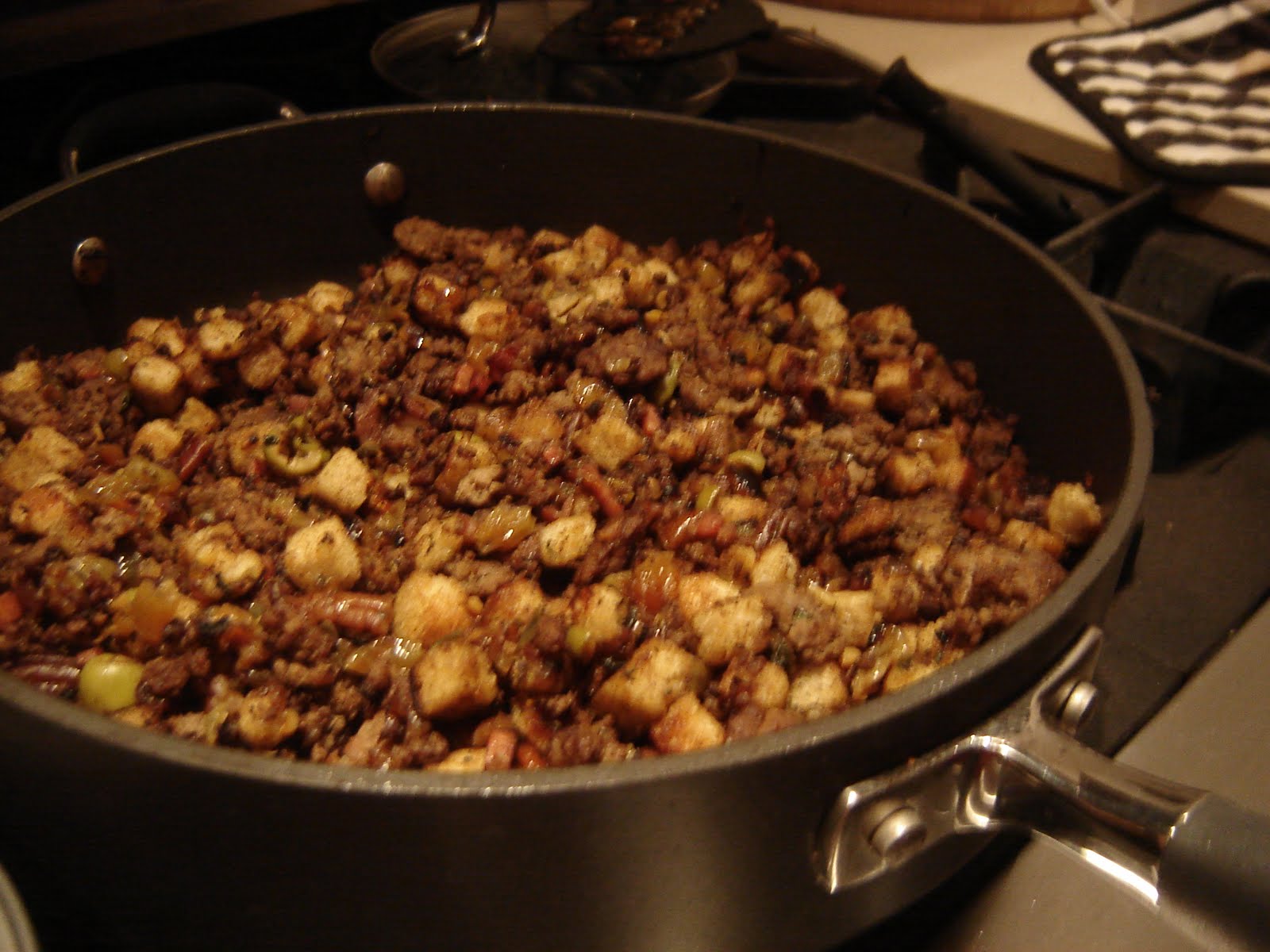
Meaty? Yes. This stuffing features meat. My Titi Janet has made this stuffing for Thanksgiving for years, and it has always been a family favorite. I have never tasted anything like it. I had to have it this year, and since she was not going to be flying out to California to make it for me, I had to take matters into my own hands. Janet emailed me the recipe, and I attempted to make it just the way she does.

I ran into one problem. I could not find one of the ingredients. This is some intense stuffing, people. It is not for sissies. I am pretty sure the ingredient list is the longest of anything I have ever made. Anyway, I could not find something called "Goya's jamon de cocinar en polvo" (oh yes, my Aunt Janet is from the Puerto Rican side of my family). Aside from being on the the list she sent me, I knew it existed only because I googled it. I went to about 4 different grocery stores (3 of which specialize in Hispanic foods), and no one had it or knew what it was. I know what each of those Spanish words mean in English (thank you Sra. Ajo); the literal translation would be "ham to cook in dust." I went ahead and took it as ham powder so I substituted a food that I thought would add just as much flavor, a food I have never regretted adding to any dish: bacon.

I cut this recipe in half since it was just for two, but I still had enough for about 8 servings. There are usually about 15 to 20 people at our Thanksgiving dinners so I would venture to guess this serves about that with leftovers. I suppose it is not technically stuffing because you do not cook it inside the turkey, but here it goes:

Titi Janet's "Will Leave You Seriously Stuffed" Stuffing:

3 – 4 lbs ground beef
½ to 1 c of cooking wine (I used a red table wine since I always have some on hand)
1 head of Garlic cloves
1 Onion
1 Bell pepper
3 packages of “Goya's jamon de cocinar en polvo” (Goya is the brand)*
3 packages of “Goya's Sazón con Azafrán” (Goya is the brand)
1 slice of cooking ham (with the bone) cut in ½” squares (I just bought some already diced ham)
1 bunch of fresh cilantro (chopped as fine as possible)
1 envelope of dry onion soup
2 cups (or to taste) of raisins (I copped them up really small since Zach hates when they bloat up. This made it so you could still taste them, but you don't get the soft soggy raisin texture when they are cooked)
2 cups (or to taste) of chopped pecans
Black pepper to taste
¼ cup of capers
1 cup of pitted stuffed olives or to taste
1/2 bag of “Pepperidge Farm Herb Seasoned Stuffing” (dry stuff)

*The Goya products are usually in the ethnic section of the grocery store"


Pour a bit of olive oil in a pot (so that the meat does not stick to the bottom when you start cooking). Cut the ham in cubes. Place the ground beef in the pot and cook until almost all brown making sure to mix the ground beef so that it does not “clump-up” while it cooks.
In a food processor or blender throw the cooking wine, black pepper, garlic, onion, bell pepper, Goya powders. Blend all together and pour in the meat with the dry onion soup and cilantro. If you do not have a food processor or blender, just chop the produce really fine.
Add the olives and capers, and continue to cook on medium for about 10-15 minutes.
Add the raisins, chopped pecans nd stuffing (mix well).
Continue cooking for another 10 minutes. The stuffing should absorb the “water/oil” from the beef while cooking.


Important note from Titi Janet: You will have to figure out the ratio between stuffing and ground beef. Just make sure it has the meat consistency more than the stuffing (mushy) consistency, but yet it is semi-mushy! And is more meaty than stuffing.

Important note from me: This turned out well for me. The bacon substitute seems to work out. I was nervous about making it and then not recognizing the taste as the same thing because it is indeed an extremely specific taste. I know it when I smell it! The part I struggled with here was since I was doing a bunch of things at one time, I think I let the meat cook too long without adding the rest of the ingredients. I think this caused it to dry out a little bit. It is important that everything stays really moist so that when you add the stuffing mixture, it has a lot of moisture to absorb.

Friday, October 30, 2009

Listen Up

A quick lesson in language etiquette completely and unofficially and probably-with-too-many-exceptions-to-be-taken-seriously made up by me:

We have all been there. You are talking to a friend, listening to a news anchor on the TV or radio, sitting in a church sermon. Then all of the sudden, out of nowhere, the person speaking in a perfectly clear American accent blurts out a pronunciation of a word in an over-enunciated foreign accent. For example:

"Oh yeah, I love Panera Bread Company. They have really great breakfast foods. Have you ever tried their KWAH-SAHNTS?"


"In an effort to start open communications with several political groups in the country, Secretary of State Hillary Clinton arrived today in PAHK-EE-STAHN."


Look, you do not have to pronounce words from other languages or even names of countries the way people in those countries would pronounce them if you are not actually speaking the language. People in Cuba do not drop words like "my-am-ee" in casual conversation. They say it the way it naturally comes to them: "mee-ah'-mee".

The obvious exception to this would be when pronouncing a word where the letters in the original language are pronounced differently to an unrecognizable extent. For example:

Ropa Vieja - In Spanish, the "i" makes an "ee" sound and the "j" makes an "h" sound so the name for this delicious dish would be nearly unrecognizable if you pronounced it, "Ro-pah Vee-jah" or "Ro-pah Vay-jah", the way you might be inclined to. The correct pronunciation is "Rope-ah Vee-eh-ha" and it is what is for dinner tonight!

Ropa Vieja is one of my favorite Cuban foods. It is shredded flank steak in a tomato-based sauce. It is full of flavor and easy to make. It is definitely a comfort food, especially when served piping hot with black beans, rice, and and type of fried plantains. Unfortunately, this dish does not photograph to well, but you know what they always say....


Don't Judge a Book Ropa Vieja:

(5 servings)

1 small can tomato paste (about 6 oz)
1 small can tomato sauce (6 to 8 oz)
2 bell peppers (I used one red, one green)
2 Cups chopped tomatoes
1/4 C red wine vinegar
2 cloves fresh garlic, minced (this should make about 2 tbsp)
1/2 tsp ground cumin
1 large onion, sliced up in 1/2 inch pieces
salt and pepper to taste
2 lbs flank steak
Bay Leaf


Mix all ingredients besides the meat together in a large bowl. Add the meat to the bowl, coating it (I mixed it around with my hands).
Transfer everything to a slow cooker and cook on low for about 7-9 hours.

Serve with rice, beans and plantains.

UPDATE 11/4/09:
I completely forgot to mention the capers. This is optional, but it makes a great addition: Use a spoon or a cup to lightly smash open some capers (about 1/4 C). Then fry them in hot oil for about 1 to 2 minutes until crispy. Put the fried capers on top of the dish right before serving.

Sunday, October 11, 2009

Costcolicious

For anyone who questions my man and my comitment to one another, let me just say we are approaching our one year anniversary of a joint Costco membership. Buying in bulk? That is love. When you can look someone in the face and say, "yes I will eventually use all of this" as you hold a 60-roll package of toilet paper, you know you have arrived as a couple.


Ah, Costco. Is it the free samples in every other isle? Is it the pizza they sell outside? Is it the favorable prices? Or is it just the option to buy candy bars in bulk (not that you ever would, but still there is the option)?

I started shopping at Costco last year as I got more into cooking and decided to be better with money. I have a good system going on, buying certain things about once every month or so from Costco and only buying produce, cheese and a few random parishables from the grocery store every week. Meat is something I have been able to save on through this process. I still buy fresh meat from the grocery store for specific meals, but I buy frozen chicken and ground beef by the 10 and 5 pound bag, respectively on the cheap at Costco. For this reason, I find myself leaning towards recipes that are made of chicken and ground beef. Imagine that.

Well, the big Costco trip was coming, and I wanted to get rid of those last two pounds of ground beef to clear the space in the freezer. When I asked Zach what dish I can make with ground beef, he replied "Beef Stroganoff". Seeing as how beef stroganoff is not made with ground beef, I eliminated that as an option (even though it does sound tasty for the future anyone have a favorite reipe?). Finally something clicked; this resulted in me clicking away on the internet for recipes for picadillo. Picadillo is a tasty Latin American dish of ground beef with a bunch of goodies mixed in. You can eat it over rice, with potaoes, alone or even as a filling for tacos and empanadas. We ate it with black beas and plantains. I made the whole two pounds of it, and we ate it for days.

Crunch Time Picadillo

(adapted from an allrecipes recipe)

3 lbs ground beef (I cut this recipe down by a third since I wa susuing 2 lbs)
1/2 large onion, chopped
2 tbsp garlic, minced
1 red pepper, chopped
1 green pepper, chopped
2 C raisins (optional...I left these out because oddly enough "somebody" I cook for specifically HATES the way rasins plump up when they are cooked)
16 oz green olives (stuffed with pimientos)
12 oz tomato paste
1/2 C water
3 oz of capers (optional...I would not use these if you include the raisins)


Brown the ground beef in a large pan.
Add onions and garlic to the meat and cook for 3 minutes.
Add all other ingredients, and bring the heat down to med-low.
Allow to simmer as long as you like or at least until all the vegetables are nice and tender.


Friday, October 2, 2009

I Go Bananas for Plantains


I think I mentioned I used to work at a small, elegant Pan-Latin American restaurant when I was in college. This introduced me to foods to which I had never given a second thought in the past. Some of my favorite things on the menu included: ropa vieja, matahambre (which was their beans and rice), empanadas, fried yuca, pinion, and churrasco. If you are ever in the Gainesville area, I highly suggest this place for lunch of dinner. I have rarely been to a restaurant where so many things on the menu were so delicious. I like to think of restaurants with such a strong menu as having a "deep bench"; the staples are there, but you can go beyond the usual suspects and still be just as satisfied (if not more so). As deep as the bench goes there, this recipe is a staple of Latin American cuisine: plantains. I have always thought of plantains as Puerto Rican bananas. My grandma makes a sort of pickled plantain dish for Christmas dinner every year, and I remember asking my mom what was in it when I was little. She told me they were plantains, and of course that required further explanation" "Puerto Rican bananas..try one." That was a mistake because as much as I love my grandma, I do not like pickled plantains.

I revisited this fruit only about 15 years later when I began to work at the restaurant. This time they were crispy, golden and fried and went undercover by the name, "tostones" on the menu. They also came in the sweet, fried variety with an almost caramelized / gooey outside; these were called "amarillos" (or some say "maduros"). Both varieties make the perfect side dishes for any Latin American meal. I like to eat them with beans and rice or ropa vieja (a shredded beef dish).

Plantains can be made two ways only as far as I am concerned at this point: fried sweet or fried green...save the pickling for cucumbers.

Tostones (fried green): They are not sweet and taste more like yuca or almost potato-like. I am pretty sure this is the first time I have actually fried something (in deep oil), and I have to admit it was easier that I thought it would be (which could really be a bad thing if you ask my waistline). These fried plantains are not the tastiest things when eaten plain. Although I am sure someone more experienced would tell you that a perfectly fried plantain can be eaten on its own. To me, it is more about the texture and how they taste when dipped in sauces and eaten with other things.


Amarillos or Maduros (sweet fried): Most people prefer the sweet fried plantains. The plantains used for amarillos are past ripe, almost black on the outside. My friend Jessica from work who loves sweet plantains literally saves them for the end of a meal and eats them like a dessert. They go well with rice and beans as well. These were fried in butter (not oil) which may have given them a richer coating.


PLANTAINS TWO WAYS

Deep Bench Tostones:

4 servings

4 plantains (they should be mostly green on the outside)
vegetable oil
kosher salt


Heat oil on high in a deep frying pan (oil should be about 1/4 inch deep)
Peel platains.
Cut across into 1 to 1 1/2 inch thick slices (should make about 8 slices for each plantain)
Place the plantain slices into the hot oil for 5 minutes, flipping once.


Remove plantains from the oil and place them on a dish lined with paper towels (to soak excess oil.
Continue to keep oil hot. If the oil is too low, you may need to add a little more to it.
Using a can or a flat plate (I used the bottom of a measuring cup), smash each plantain down until they are each 1/4 inch thick.
Place the smashed plantains back into the oil for about 1 minute on each side or until they are a deep golden color.
Toss the tostones with kosher salt right after removing them from hot oil so that the salt sticks.


For a dip for tostones, I whipped up my version of a "mojo" sauce they used to serve at the restaurant: equal parts ketchup and mayonnaise mixed with plenty of garlic powder and salt (pictured below)


For another dipping option, my amazing friend, Amanda, recommends the following:
Mix a ton of fresh pressed garlic with olive oil and let it sit for awhile or overnight. Fork it over the tostones or dip them into it. Garlicky awesome! WARNING: for garlic lovers only.


Ooey Gooey Amarillos

(a Tyler Florence recipe)

makes 2-3 servings


2 to 3 ripe black plantains (or almost black)
4 tablespoons unsalted butter
1 teaspoon ground cinnamon
1 teaspoon vanilla extract
2 tablespoons brown sugar

Peel the plantains.
Heat butter in a large skillet and place over medium low heat (using high heat may cause them to burn quickly due to the sugar content).
Fry the plantains in a single layer, until golden on the bottom then turn over with a spatula. Add the cinnamon, vanilla, and sugar and let cook a few more seconds, just to begin caramelizing the sugar.

Wednesday, June 10, 2009

Ex-Boyfriend Empanadas

There was a Coca Cola commercial a few years ago that was set in an apartment with two roommates. One of them comes home and finds a note from his mom on the counter that says, "Tony, I hope you enjoy the empanadas and coke I left for you in the fridge." Excitedly, Tony goes to look in the refrigerator as the suddenly wide-eyed roommate sits at the counter scarfing down the last bit of the tasty snack and cool beverage.
...or something like that.

For some reason, this ad really stuck with me. Unfortunately for Coca Cola, it was more about the empanadas than it was about the soda. I really wanted to look into these empanadas, which I soon learned were Latin American meat-stuffed turnovers. Delicious.

My new interest in this particular dish happened to coincide with the time a good friend of mine (who lived next door to me - apartment 301 - in college) was dating an Argentinian hunk. One afternoon, having nothing better to do (which was often the case in college life), I poked my head in good ole' apartment 301. To my delight, my friend and the Argentinian were making empanadas in her kitchen. I stood by, took mental notes, and then later tried making them on my own. I have made empanadas several times since that day. After having experimented with several techniques, ideas, and ingredients in an attempt to make them my own, I finally feel like I have found my favorite recipe for them in my last couple of batches. I am using the term, "recipe", loosely here because you can really just stuff the dough with anything you want. Things I have tried include, pork, chicken, and plain cheese.

When people break up, they take things with them from the relationship that they will carry with them forever, but so do the people around them. Well, I am taking these empanadas and so will my kids and their kids, always remembering where they came from. So since I am a big fan of combining words, please allow me to present to you:

Ex-Panadas

1 C water (room temperature) in a small bowl
1 large egg
1 lb ground beef
1 tbsp olive oil
1 C green olives (stuffed with pimiento) – chopped
1 medium white onion - chopped
2 tbsp minced garlic (or two cloves)
salt and black pepper (to taste)
2 C shredded white cheddar cheese
Kosher salt (to taste)
1 package of frozen dough - thawed (pictured below because I am not exactly sure how to explain it) You can use any kind of frozen dough including puff pastry dough (if you want more of a flaky empanada), a pie crust dough, or one that you can find in the ethnic frozen section of any major grocery store (yes, this section does exist…this is the kind of dough pictured below because it is what I prefer to use). There are generally two sizes (one is about six inches in diameter, the other is about 9). I prefer using the ones that are about 6 inches in diameter for smaller empanadas, but the bigger ones can be good if you are using them more a main dish instead of a side or an appetizer.


Heat (on high) olive oil in a large pan for 1 minute

Add the ground beef to the pan, and stir around until browned

Add the chopped onion and olives (with pimiento), salt, pepper, and minced garlic to the meat and continue cooking until onions begin to feel tender (about 3 minutes), mixing well.

Remove meat from heat and drain any excess juices or fat.

To assemble empanadas:

Beat egg in a small bowl and set aside

Place one dough round flat on a clean countertop (you may want to sprinkle a little bit of flour on the counter to keep the dough from sticking to it)

Dip your finger in the bowl or water, and neatly run it around the edges of the round of dough on only the side facing up (this is to help the edges stick together later on).

Spoon meat mixture (about two heaping tbsp) onto dough and sprinkle generously with shredded cheese. Example (without the cheese):


Fold dough, enclosing mixture in a pocket.

Seal the edges together any way you like. You can pinch the edges together to make patterns, you can fold the edges inward, or you can use a fork and press the edges together using the bottom of it to sandwich the dough between it and the counter. You just have to figure out what works best and is easiest for you. They should look something like this:


Transfer the empanadas onto a baking sheet (sprayed very lightly with cooking spray).

With a pastry brush, coat the entire surface of each empanada with the beaten egg.

Lightly sprinkle a pinch of kosher salt over each empanada.

Bake at about 375 degrees F for about 20-25 minutes (until tops are golden). Baking temperature may vary due to the kind of dough you are using, but there should be rough baking instructions on the package.


A couple of notes:

I borrowed some pictures for this post to better illustrate the process because it really is difficult to explain! However, below is a "Bite Me" original:


I like to make a bunch and freeze the leftovers. I have found the best way to store them is to wrap them individually in foil and then you can put them in freezer bags or a freezer-safe plastic storage container before putting them in the freezer (make sure they are completely cool before you freeze them). When you are ready to eat them up, just unwrap how ever many you would like to eat and put them back in the oven until they are heated all the way through. You can also put them in the microwave on high for 3 to 3 1/2 minutes (for one or two at a time).